Engineering a 240% Growth Engine For Local Media via Meta Ads
Written by Hafiz Dhanani · Topics: Meta Ads, Native Lead Forms, Meta campaign structure, CBO, head-to-head testing, Meta Ads targeting (lookalike, open/broad, interest), Meta CAPI + Attribution Pipeline
Executive Summary
- Role: VP of Growth Marketing
- The Outcome: Scaled total active email subscribers from ~50,000 to 170,000+ (+240%) in under 12 months while growing monthly ad spend from $5K to $60K+ (12x) across a portfolio of 10+ media brands.
- Key Insight 1: Solved the Unit Economics problem for the portfolio by engineering a Native Teaser Funnel, which reduced Customer Acquisition Cost (CAC) by 50% (from ~$4.00 → ~$1.97) compared to generic "Sign Up" campaigns.
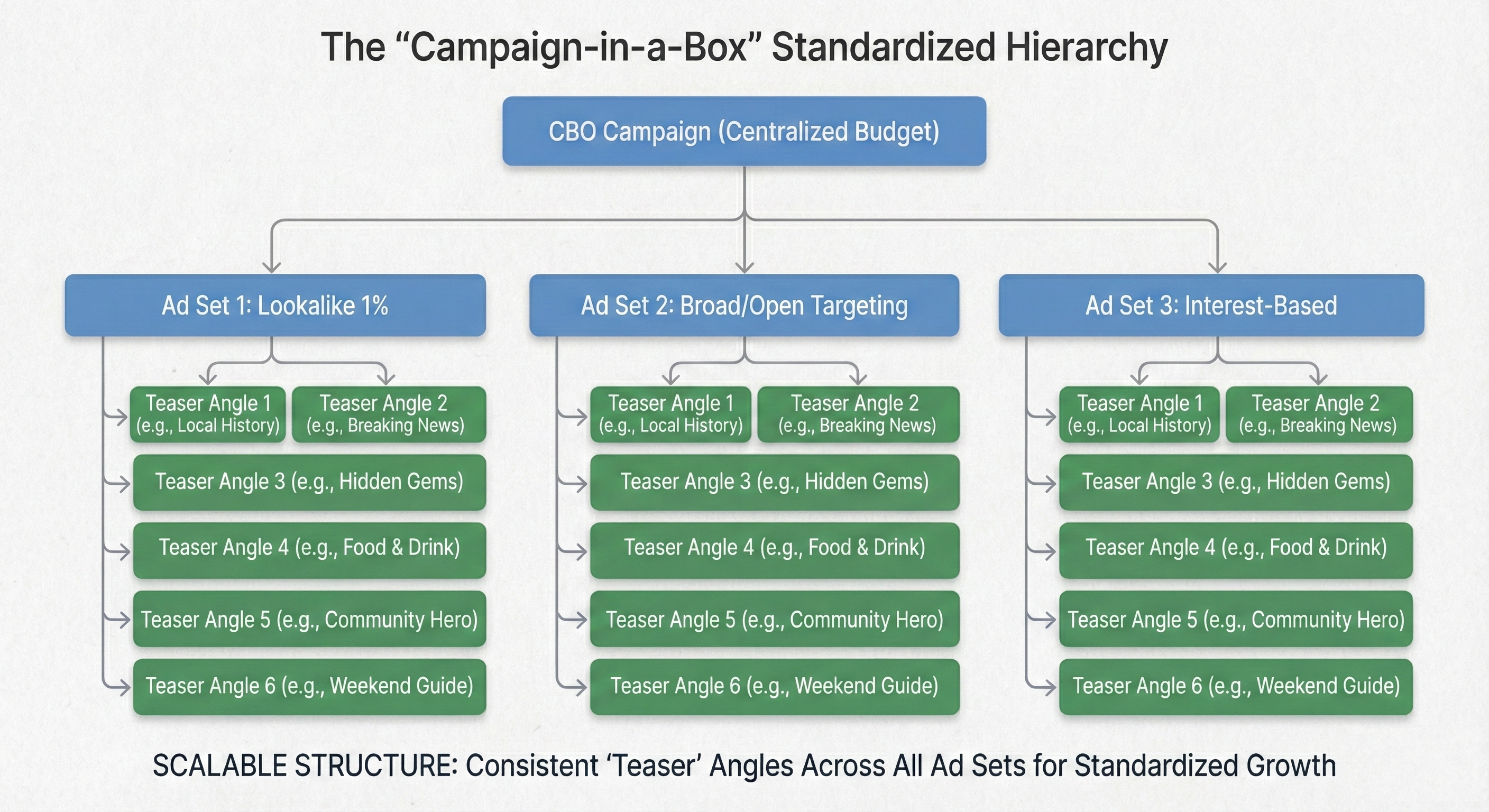
- Key Insight 2: Simple CBO campaign structure with 3 ad sets (lookalike vs. open vs. interest) and the same 6 articles in each ad set forced a head-to-head audience test.
1. The Challenge: The Unit Economics Barrier
Overstory Media Group (OMG) needed to launch new local media brands rapidly while scaling established ones. However, the existing acquisition model was financially broken.
- The Ambiguity: There was no established framework for growth; every market launch was an ad-hoc experiment.
- The Economic Barrier: Across both new and established brands, the standard "Sign Up for our Newsletter" pitch was yielding a ~$4.00 CPA. At this price point, the unit economics for a free newsletter product were unsustainable, effectively blocking our ability to scale paid acquisition.
2. The Strategy: The "Native Teaser" Pivot
To make the economics work (target <$2.50 CPA), we didn't have the luxury of isolating variables over months of testing. I hypothesized we needed to drastically reduce friction and increase intent simultaneously. We moved away from the "Generic Web Funnel" to a "Native Content Funnel."
The Architecture:
- Variable A (Friction Reduction): Switched from external landing pages to Meta Native Lead Forms, keeping the user on-platform to maximize conversion rate.
- Variable B (Psychological Hook): Replaced "Sign Up" messaging with "Article Teasers": snippets of high-performing local stories that required a signup to finish reading.
Note: Because we were early-stage and needed to drop CPA immediately to unlock budget, we deployed these changes simultaneously. The compound effect was the breakthrough lever.
The "Campaign-in-a-Box" Structure: To ensure this could be repeated, I standardized the ad account structure:
- 1 Campaign with Campaign Budget Optimization (CBO)
- 3 Ad Sets for systematic audience testing: Lookalike (1%) vs. Broad/Open (Algo) vs. Interest.
- Creative: 6 consistent "Teaser" angles per ad set across all audiences to isolate targeting as the independent variable.
The Data Pipeline:
To ensure we optimized for retention and not just cheap leads, I built a closed-loop system:
- Acquisition (Meta Native Forms): Captured intent with zero load-time friction.
- Middleware: Zaps to route leads to specific city lists.
- Feedback Loop (ActiveCampaign): Passed UTMs and Ad IDs into the CRM to track downstream metrics (Open Rate, CTR) back to the specific Creative Angle.
3. The Pilot: Fraser Valley Current
I used the Fraser Valley brand to validate this new architecture.
The Setup & Execution:
- Tech Stack: Meta Native Lead Forms → Custom Zapier Middleware → ActiveCampaign.
- Creative Strategy: Each ad set featured the same 6 articles/angles to ensure consistent brand messaging and pure audience testing.
The Data (Three-Tier Audience Results):
- Lookalike Audiences (1%): Delivered the best performance at $2.09 CPL.
- Open/Broad Targeting: Performed nearly as well at $2.14 CPL, providing scale without manual constraints.
- Diagnostic Note: We identified a 19.68% auction overlap with lookalikes, suggesting that Broad targeting was effectively finding the same users without the need for custom audiences.
- Interest-Based Targeting: The worst performer at $2.28 CPL with lower spend volume, proving that algorithmic discovery outperformed manual selection.
The Pilot Outcome: The pivot to the "Native Teaser" funnel immediately dropped the overall blended CPA to $1.97 (vs. the $4.00 historical benchmark). By cutting the cost of acquisition in half, we unlocked significant budget scale, moving from tentative experiments to an "always-on" acquisition engine.
4. Portfolio-Wide Scale
Once the economics were validated at <$2.00, I rolled this playbook out across the 10+ brand portfolio.
- Standardization: We eliminated the "How do we launch?" ambiguity. The Native Teaser framework became the standard operating procedure (SOP) for all new markets.
- Macro Impact: This efficiency unlock was the primary driver that allowed us to scale the total network to 170,000+ active subscribers.
5. Key Learnings
- Viability > Purity: We changed the funnel (Web → Native) and the Creative (Generic → Teaser) at the same time. While strict A/B testing would dictate isolating them, the business reality required immediate unit economic viability. The compound effect solved the problem.
- Content-Led Acquisition: Users didn't want to "subscribe to a newsletter"; they wanted to "read a story." By aligning the ad creative with the user's curiosity (the Teaser), we lowered the barrier to entry significantly.
- Simplicity Scales: By proving that Broad/Open targeting worked within this funnel ($2.14 CPA), we removed the need for complex audience research in every new city, allowing us to launch faster with confidence.
Written by Hafiz Dhanani